Wispr review
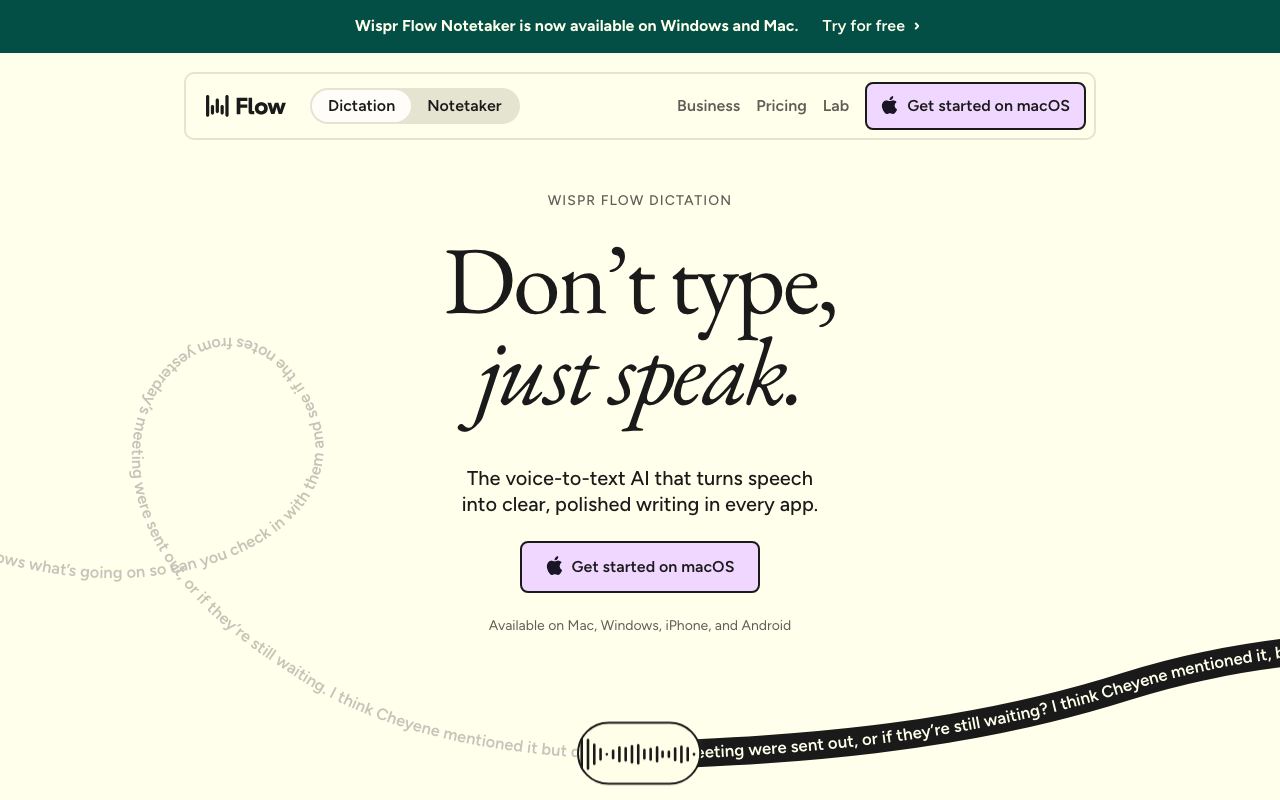
A voice-input platform expanding beyond dictation toward multi-step workplace automation.
WireTensors rating
Time saved: Saves ~4–6 hours per week on manual transcription, form-filling, and task documentation for hands-busy roles..
Key facts
| Tool | Wispr |
|---|---|
| Category | Productivity |
| Pricing | Pricing not publicly listed at time of review |
| Free tier | No |
| WireTensors rating | 4 / 5 |
| Best for | Teams and professionals whose work is hands-busy or eyes-busy and who need rapid input and task automation through voice. |
| Avoid if | You require a lightweight, free, or privacy-first voice tool, or if your workflows demand high accuracy on technical terminology without custom training. |
| Affiliate commission | Pending affiliate program review |
| Cookie window | N/A |
| Last verified | 2026-08-18 |
Overview
Wispr is a voice-input and automation platform that has raised $280 million at a $2 billion valuation, making it one of the largest funded voice-AI companies outside the major model labs. The company's stated pivot from 'dictation' toward broader workplace automation signals an ambition beyond simple speech-to-text—suggesting the product can now accept voice input to trigger multi-step workflows, create structured records, and integrate with downstream tools. The company is well-capitalised and benefits from sustained venture interest in voice as a primary computing interface, particularly for workers in hands-busy environments (field service, healthcare, logistics, manufacturing). The substantial funding round indicates investor confidence in the market opportunity and the company's technical execution. However, public documentation of feature set, supported integrations, accuracy benchmarks, and pricing remains limited as of August 2026. Wispr competes with ElevenLabs (primarily a voice synthesis and API provider), Google Recorder (transcription-focused), and built-in OS voice assistants, but positions itself at the workflow automation level rather than as a pure speech-recognition service. The expansion beyond dictation implies potential overlap with no-code automation platforms like Zapier or Make, though voice input as the primary trigger point is less common in that market. Pricing, availability by region, and language support are not publicly specified. Known limitations include sparse published case studies, unclear integration breadth with enterprise tools, and no public benchmark data on accuracy, latency, or cost per hour of transcription. The product appears optimised for speed of input and workflow initiation rather than depth of transcription control or privacy guarantees, which may limit appeal in regulated sectors.
Pros
- Strong venture backing ($280 million at $2 billion valuation) signals sustained product investment and runway
- Voice as primary input mode reduces friction for hands-busy workflows (driving, manufacturing, fieldwork)
- Positioning toward multi-step automation suggests capability beyond simple speech-to-text
Cons
- Specifics on what 'expansion beyond dictation' entails remain vague and unverified
- Comparison to mature alternatives like Google Recorder or ElevenLabs voice APIs unclear
- Unclear how well it handles ambient noise, technical jargon, or non-English languages at scale
Who it is for
- Best for: Teams and professionals whose work is hands-busy or eyes-busy and who need rapid input and task automation through voice..
- Avoid if: You require a lightweight, free, or privacy-first voice tool, or if your workflows demand high accuracy on technical terminology without custom training..
Who this is for
Field service technicians, construction site supervisors, nurses and clinicians in care settings, delivery and logistics professionals, warehouse operators, and manufacturing floor workers. Researchers conducting fieldwork. Sales professionals taking notes during client calls. Anyone whose role requires operating in a hands-busy or safety-critical environment. Teams valuing speed of input over typing or clicking through forms.
Who should skip this
Privacy-conscious individuals uncomfortable with cloud voice processing. Organisations with strict data residency or HIPAA compliance requirements who do not have data-handling agreements in place. Users seeking free or very-low-cost alternatives. Teams needing bullet-proof accuracy on specialised terminology without model fine-tuning.
Verdict
Wispr's substantial funding and explicit pivot toward automation suggest genuine product-market fit and differentiation from commodity speech-to-text services. For hands-busy professionals and field teams, it likely offers meaningful efficiency gains. However, the opacity around features, pricing, and technical specifications makes independent verification difficult; interested organisations should request a detailed product demo and usage data before committing.
User reviews
Real reader reviews — separate from WireTensors' own editorial rating above. Every submission is moderated before it appears here.
Loading reviews…
Write a review
Wispr FAQ
What is Wispr? +
Wispr is a voice-input and automation platform that has raised $280 million at a $2 billion valuation, making it one of the largest funded voice-AI companies outside the major model labs. The company's stated pivot from 'dictation' toward broader workplace automation signals an ambition beyond simple speech-to-text—suggesting the product can now accept voice input to trigger multi-step workflows, create structured records, and integrate with downstream tools. The company is well-capitalised and benefits from sustained venture interest in voice as a primary computing interface, particularly for workers in hands-busy environments (field service, healthcare, logistics, manufacturing). The substantial funding round indicates investor confidence in the market opportunity and the company's technical execution. However, public documentation of feature set, supported integrations, accuracy benchmarks, and pricing remains limited as of August 2026. Wispr competes with ElevenLabs (primarily a voice synthesis and API provider), Google Recorder (transcription-focused), and built-in OS voice assistants, but positions itself at the workflow automation level rather than as a pure speech-recognition service. The expansion beyond dictation implies potential overlap with no-code automation platforms like Zapier or Make, though voice input as the primary trigger point is less common in that market. Pricing, availability by region, and language support are not publicly specified. Known limitations include sparse published case studies, unclear integration breadth with enterprise tools, and no public benchmark data on accuracy, latency, or cost per hour of transcription. The product appears optimised for speed of input and workflow initiation rather than depth of transcription control or privacy guarantees, which may limit appeal in regulated sectors.
How much does Wispr cost? +
Wispr pricing: Pricing not publicly listed at time of review. Always confirm current pricing on the official site, as plans change.
Does Wispr have a free tier? +
No. Wispr does not offer an ongoing free plan, though a trial may be available.
What is Wispr best for? +
Teams and professionals whose work is hands-busy or eyes-busy and who need rapid input and task automation through voice..
When should you avoid Wispr? +
Avoid Wispr if: You require a lightweight, free, or privacy-first voice tool, or if your workflows demand high accuracy on technical terminology without custom training..
What are the main pros of Wispr? +
Strong venture backing ($280 million at $2 billion valuation) signals sustained product investment and runway; Voice as primary input mode reduces friction for hands-busy workflows (driving, manufacturing, fieldwork); Positioning toward multi-step automation suggests capability beyond simple speech-to-text.
What are the main cons of Wispr? +
Specifics on what 'expansion beyond dictation' entails remain vague and unverified; Comparison to mature alternatives like Google Recorder or ElevenLabs voice APIs unclear; Unclear how well it handles ambient noise, technical jargon, or non-English languages at scale.
Does Wispr have an affiliate program? +
No public affiliate program is listed for Wispr at the time of review.
How is Wispr rated? +
WireTensors rates Wispr 4 out of 5, based on capability, value, and fit for its intended use case.
What category does Wispr fall under? +
Wispr is categorised under productivity on WireTensors.
When was this Wispr review last verified? +
This review was last verified on 2026-08-18 against the vendor's official site.
Reviewed by Arjun Mehta
Editorial lead overseeing WireTensors' research, sourcing and verification process
Last verified:
Sources
- Wispr — official website — verified