Slaunt review
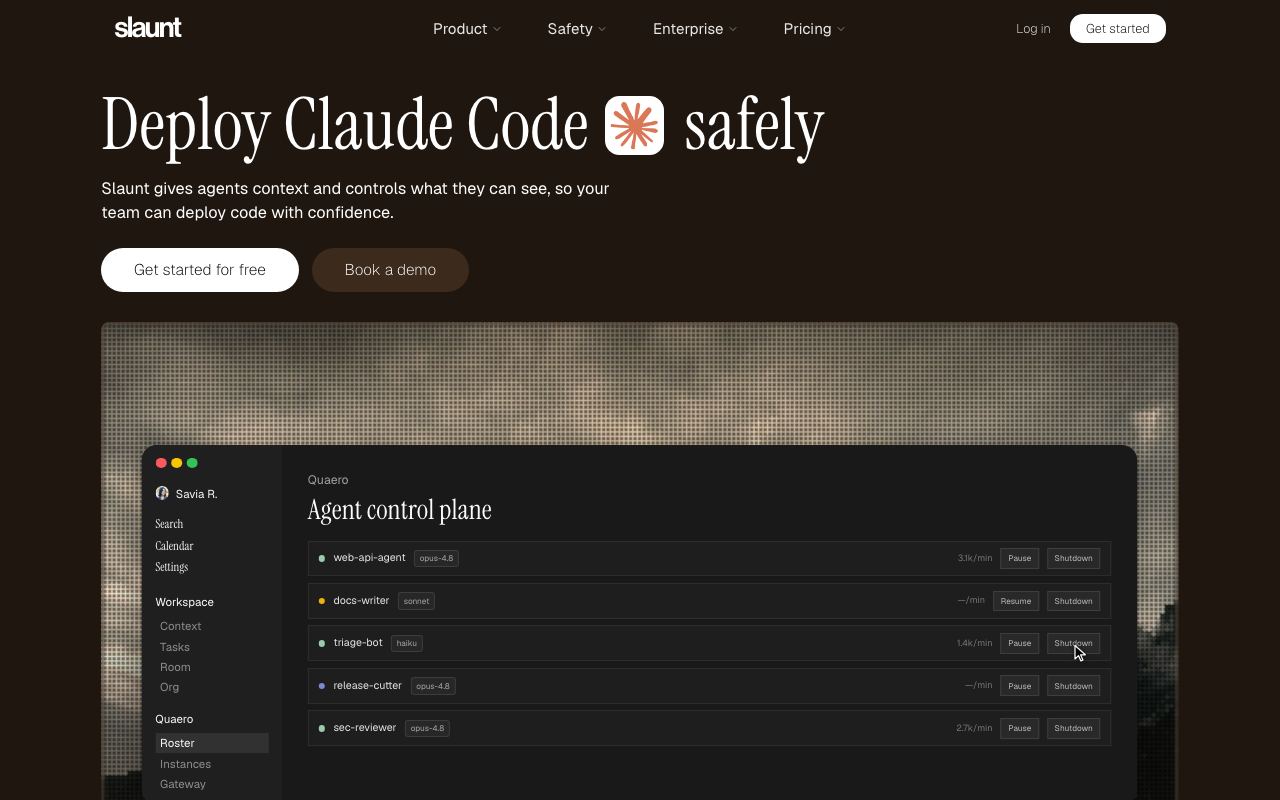
A policy and access-control layer that governs what AI agents can execute, modify, or access.
WireTensors rating
Time saved: Reduces ~2–4 hours per week of security review and incident response by preventing unintended agent actions and data access breaches..
Key facts
| Tool | Slaunt |
|---|---|
| Category | Productivity |
| Pricing | Pricing not publicly listed at time of review |
| Free tier | No |
| WireTensors rating | 3.7 / 5 |
| Best for | Teams deploying autonomous AI agents in production and needing guardrails to prevent unintended actions or data access. |
| Avoid if | You are building standalone chatbots or simple retrieval systems where agent autonomy is not a concern. |
| Affiliate commission | Pending affiliate program review |
| Cookie window | N/A |
| Last verified | 2026-08-18 |
Overview
Slaunt is a security and governance layer designed specifically for autonomous AI agents, allowing teams to define and enforce policies around agent capabilities, data access, and action execution. Rather than attempting to restrict the reasoning of the underlying model, Slaunt operates at the execution boundary—controlling what actions the agent is permitted to take, what systems it can interact with, and what data it can read or modify. This approach mirrors traditional principle-of-least-privilege access control but extended to agents. The product was unveiled via Hacker News' Show HN forum in August 2026, indicating it is in active development and early customer adoption. Public information is sparse; the website and any documentation do not yet provide clear specifics on the policy language, supported agent frameworks (e.g., LangChain, Anthropic SDK, OpenAI agents), or integration patterns. The underlying model or evaluation approach is not disclosed. Slaunt addresses a material gap in the current agent ecosystem: most agent frameworks and LLM APIs delegate safety entirely to prompt engineering or model fine-tuning, neither of which reliably prevent agents from executing unintended actions when given access to external tools. Competing approaches include custom approval workflows (manual intervention), sandbox environments (Replit, GitHub Codespaces), or architectural separation (e.g., agents with read-only database access). Slaunt's differentiator is a declarative policy layer that sits between the agent's decision-making and action execution, allowing fine-grained control without code changes. Current limitations include lack of published case studies, no public benchmarks on false-positive rates or latency impact, and unclear scope of supported agent types (e.g., multi-agent systems, hierarchical agents, or agents using real-time APIs). Integration effort and API surface remain undocumented.
Pros
- Directly addresses growing security concern around agent autonomy and unintended actions
- Granular control model (define what agents can do and access) fits emerging enterprise need
- Early-stage positioning on Hacker News indicates active development and small, engaged user base
Cons
- Minimal public documentation; feature set, supported agent frameworks, and API surface unclear
- No published benchmarks on false-positive rates, latency overhead, or integration effort
- Unclear how it handles reasoning-heavy agents that may infer unintended permissions
Who it is for
- Best for: Teams deploying autonomous AI agents in production and needing guardrails to prevent unintended actions or data access..
- Avoid if: You are building standalone chatbots or simple retrieval systems where agent autonomy is not a concern..
Who this is for
Platform engineers and DevOps professionals deploying AI agents in production environments. Security and compliance officers evaluating agent-based automation. Teams using agents for financial, HR, or database operations where safety and control are paramount. Organisations building internal AI agent infrastructure or multi-tenant agent platforms. Engineering leads at companies integrating third-party agents into their stack.
Who should skip this
Teams using only stateless chatbots or read-only AI assistants without executable actions. Small startups without dedicated security or compliance infrastructure. Organisations satisfied with their current AI agent risk management. Development teams building toys or proof-of-concepts that do not involve sensitive operations or data.
Verdict
Slaunt tackles a timely and important problem as agent-based automation grows in production environments. The principle-of-least-privilege approach is sound and differentiates it from existing model-safety solutions. However, extreme early-stage status and minimal public information make it a research-only recommendation at present; interested teams should request a technical deep-dive and pilot programme.
User reviews
Real reader reviews — separate from WireTensors' own editorial rating above. Every submission is moderated before it appears here.
Loading reviews…
Write a review
Slaunt FAQ
What is Slaunt? +
Slaunt is a security and governance layer designed specifically for autonomous AI agents, allowing teams to define and enforce policies around agent capabilities, data access, and action execution. Rather than attempting to restrict the reasoning of the underlying model, Slaunt operates at the execution boundary—controlling what actions the agent is permitted to take, what systems it can interact with, and what data it can read or modify. This approach mirrors traditional principle-of-least-privilege access control but extended to agents. The product was unveiled via Hacker News' Show HN forum in August 2026, indicating it is in active development and early customer adoption. Public information is sparse; the website and any documentation do not yet provide clear specifics on the policy language, supported agent frameworks (e.g., LangChain, Anthropic SDK, OpenAI agents), or integration patterns. The underlying model or evaluation approach is not disclosed. Slaunt addresses a material gap in the current agent ecosystem: most agent frameworks and LLM APIs delegate safety entirely to prompt engineering or model fine-tuning, neither of which reliably prevent agents from executing unintended actions when given access to external tools. Competing approaches include custom approval workflows (manual intervention), sandbox environments (Replit, GitHub Codespaces), or architectural separation (e.g., agents with read-only database access). Slaunt's differentiator is a declarative policy layer that sits between the agent's decision-making and action execution, allowing fine-grained control without code changes. Current limitations include lack of published case studies, no public benchmarks on false-positive rates or latency impact, and unclear scope of supported agent types (e.g., multi-agent systems, hierarchical agents, or agents using real-time APIs). Integration effort and API surface remain undocumented.
How much does Slaunt cost? +
Slaunt pricing: Pricing not publicly listed at time of review. Always confirm current pricing on the official site, as plans change.
Does Slaunt have a free tier? +
No. Slaunt does not offer an ongoing free plan, though a trial may be available.
What is Slaunt best for? +
Teams deploying autonomous AI agents in production and needing guardrails to prevent unintended actions or data access..
When should you avoid Slaunt? +
Avoid Slaunt if: You are building standalone chatbots or simple retrieval systems where agent autonomy is not a concern..
What are the main pros of Slaunt? +
Directly addresses growing security concern around agent autonomy and unintended actions; Granular control model (define what agents can do and access) fits emerging enterprise need; Early-stage positioning on Hacker News indicates active development and small, engaged user base.
What are the main cons of Slaunt? +
Minimal public documentation; feature set, supported agent frameworks, and API surface unclear; No published benchmarks on false-positive rates, latency overhead, or integration effort; Unclear how it handles reasoning-heavy agents that may infer unintended permissions.
Does Slaunt have an affiliate program? +
No public affiliate program is listed for Slaunt at the time of review.
How is Slaunt rated? +
WireTensors rates Slaunt 3.7 out of 5, based on capability, value, and fit for its intended use case.
What category does Slaunt fall under? +
Slaunt is categorised under productivity on WireTensors.
When was this Slaunt review last verified? +
This review was last verified on 2026-08-18 against the vendor's official site.
Reviewed by Arjun Mehta
Editorial lead overseeing WireTensors' research, sourcing and verification process
Last verified:
Sources
- Slaunt — official website — verified